
ERPC Migrates Solana RPC (HTTP / WebSocket) to Firedancer Across All Regions, Improving Low Latency and Stability Even for Shared HTTPS Endpoints
ERPC, operated by ELSOUL LABO B.V. (Headquarters: Amsterdam, the Netherlands; CEO: Fumitake Kawasaki) and Validators DAO, announces that it has migrated all Solana RPC nodes across all regions to the Firedancer client, excluding nodes dedicated to SWQoS in the Frankfurt region.
As a result of this migration, ERPC’s Solana RPC—including shared HTTPS RPC endpoints—has achieved further improvements in low latency and processing stability. Feedback from existing users also indicates that ERPC’s shared endpoints are perceived as faster when compared with other providers’ dedicated RPC nodes.
Structural Challenges of Latency and Stability in Solana RPC
In Solana development and operations, RPC is an essential foundation. Transaction submission, account state retrieval, and real-time observation of application behavior all rely on RPC.
At the same time, RPC latency is determined by a combination of factors, including physical distance, network paths, TLS encryption overhead, node implementation efficiency, and load concentration. In shared RPC environments in particular, the use of HTTPS introduces unavoidable TLS overhead, and the shared-node model tends to amplify latency fluctuations and variability.
ERPC has continuously addressed these challenges through its underlying architecture, including global node placement, edge-based data delivery, and Shreds feeding across all nodes. The migration to Firedancer is positioned as an extension of these ongoing efforts.
Design Philosophy and Objectives of Firedancer
Firedancer is a Solana client fully tuned in the C programming language, designed not to optimize for theoretical benchmarks but to raise the practical performance ceiling in real-world operations.
Compared to the widely used agave client, Firedancer applies extensive optimizations to memory management, processing paths, and network handling, enabling more stable low-latency performance and higher processing efficiency under identical hardware conditions.
Validation Results and Operational Insights from Testnet and Devnet
ERPC has deployed Firedancer in its testnet and devnet RPC environments and conducted continuous validation. Through this process, ERPC confirmed that Firedancer can reduce memory usage while delivering more stable low latency and increasing overall processing limits compared to the agave client.
In addition, ERPC observed cases where server configurations that struggled to operate stably with agave were able to run successfully with Firedancer. This characteristic is significant not only for performance, but also for enabling energy-efficient and highly effective operations.
These findings are based not on theoretical values or synthetic benchmarks, but on real-world operation and continuous observation within ERPC’s infrastructure.
Details of the All-Region Migration at ERPC
With this update, ERPC has migrated all Solana RPC nodes to the Firedancer client, excluding nodes dedicated to SWQoS in the Frankfurt region.
This migration applies to the entire configuration, including shared HTTPS RPC endpoints. Existing users benefit from the latency and stability improvements provided by Firedancer without requiring any configuration changes or migration work on their side.
For the Frankfurt region, ERPC plans to proceed with a phased migration once Firedancer’s SWQoS functionality is fully supported.
ERPC Architecture Based on Global Deployment and Shreds Feeding
ERPC provides Solana RPC through full nodes deployed across seven global locations. In addition, data is delivered through the shortest possible paths from more than 300 edge data centers worldwide.
All locations and all nodes receive and feed Shreds, adopting an architecture that directly bypasses Shreds circulating within the Solana validator network.
Because Shreds propagate over UDP and are prioritized according to stake weight, RPC nodes—which do not hold stake—tend to receive data later in conventional configurations, often resulting in delayed block tracking.
By directly ingesting Shreds propagation paths into its RPC nodes, ERPC enables validator-level block catch-up speeds even within an RPC environment. This approach delivers consistently fast response characteristics across all regions and all nodes.
Positioning of Shared RPC, Unlimited Endpoints, and VPS
Following the Firedancer migration, shared HTTPS RPC endpoints have also demonstrated improvements in both low latency and stability.
Furthermore, Unlimited Endpoints eliminate TPS limits and remove approximately 20 ms of overhead associated with TLS (HTTPS), enabling HTTP / WebSocket RPC usage. When combined with ERPC’s VPS offerings on the same platform, this configuration enables core Solana RPC methods to be executed in as little as 2 ms.
Traditionally, achieving such a setup required dedicated RPC nodes costing several thousand dollars, along with separately provisioned adjacent servers. ERPC delivers comparable performance at approximately one-tenth of that cost.
Pricing Information
Please refer to the pricing tables below for Shared Solana RPC, Unlimited Endpoints, and VPS plans.
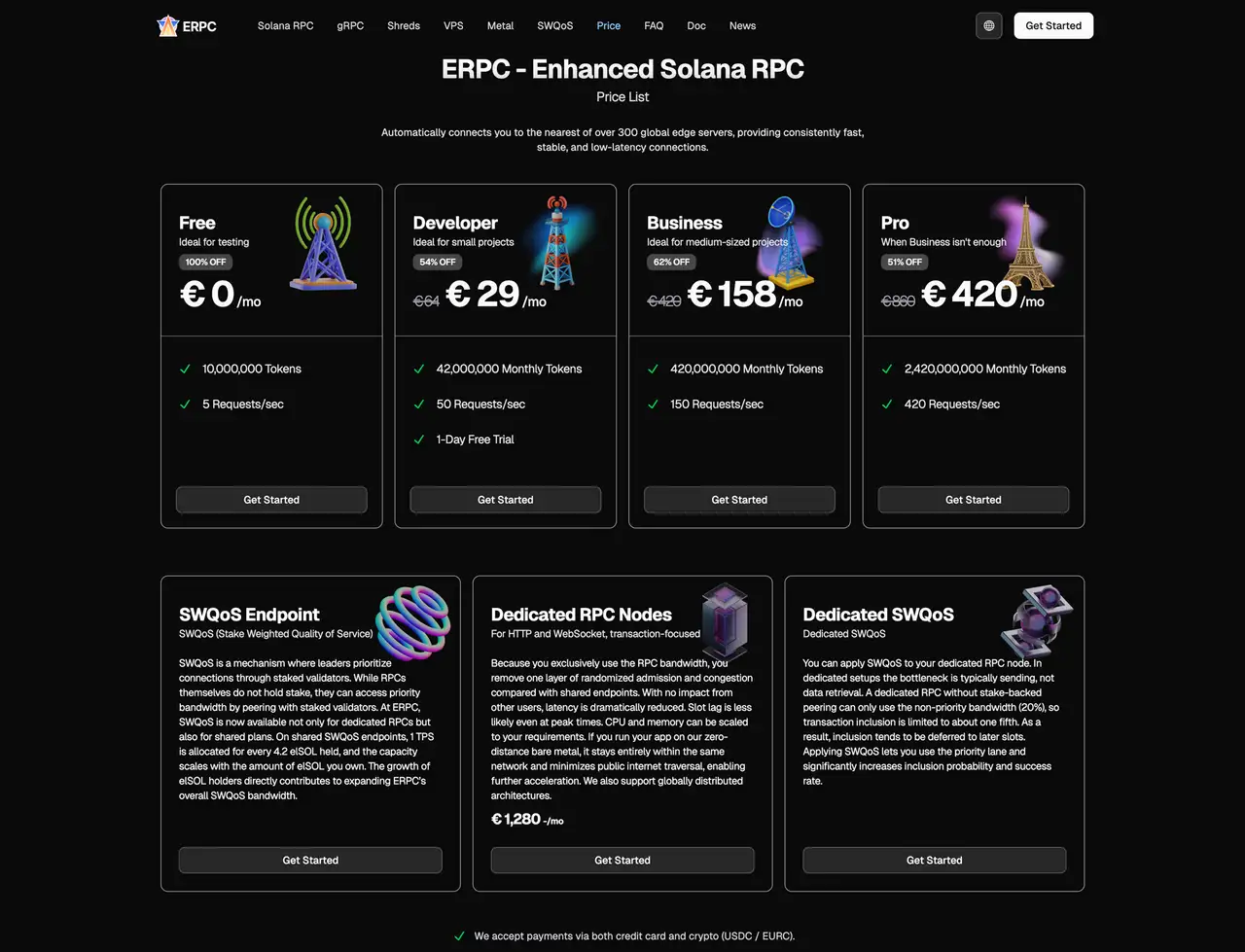
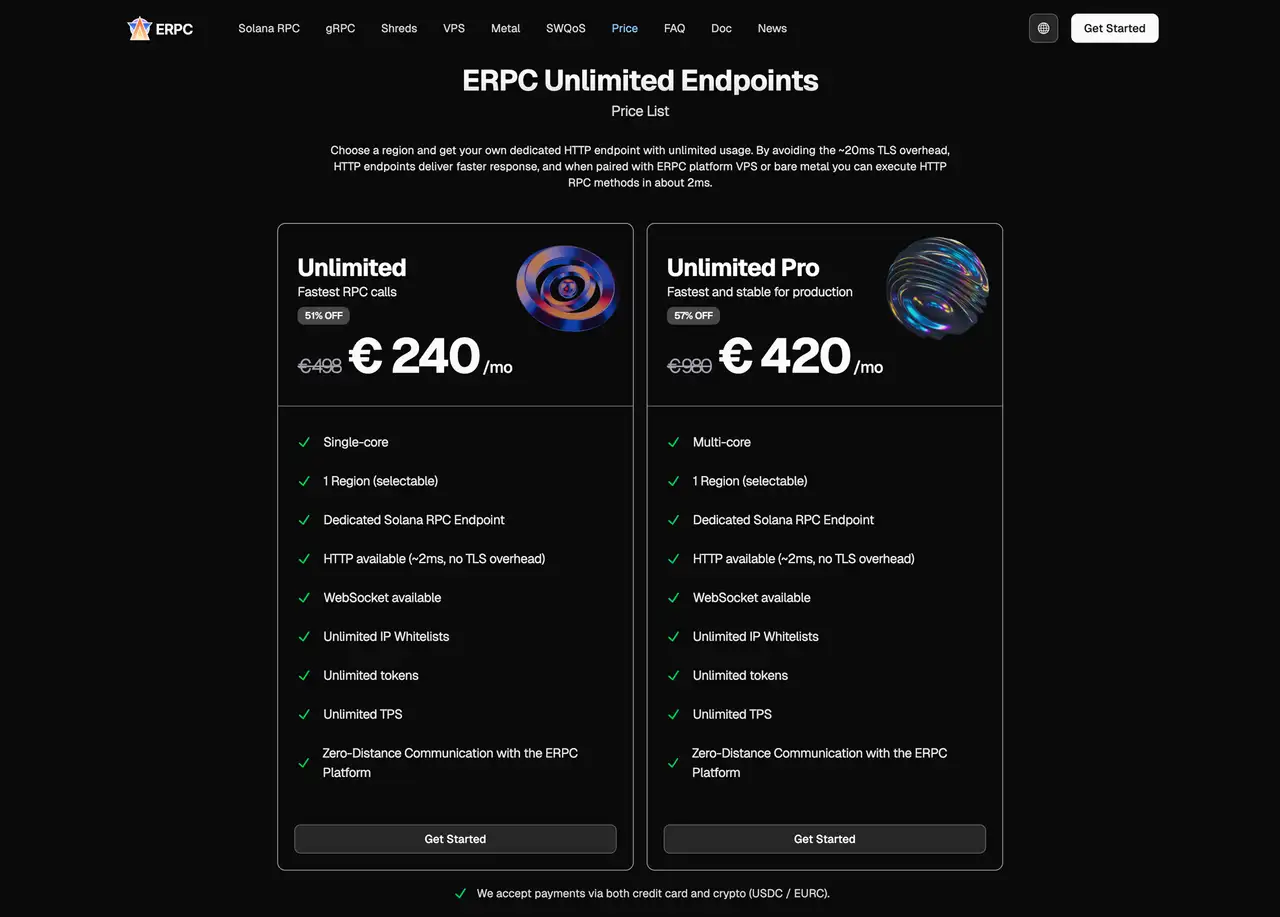
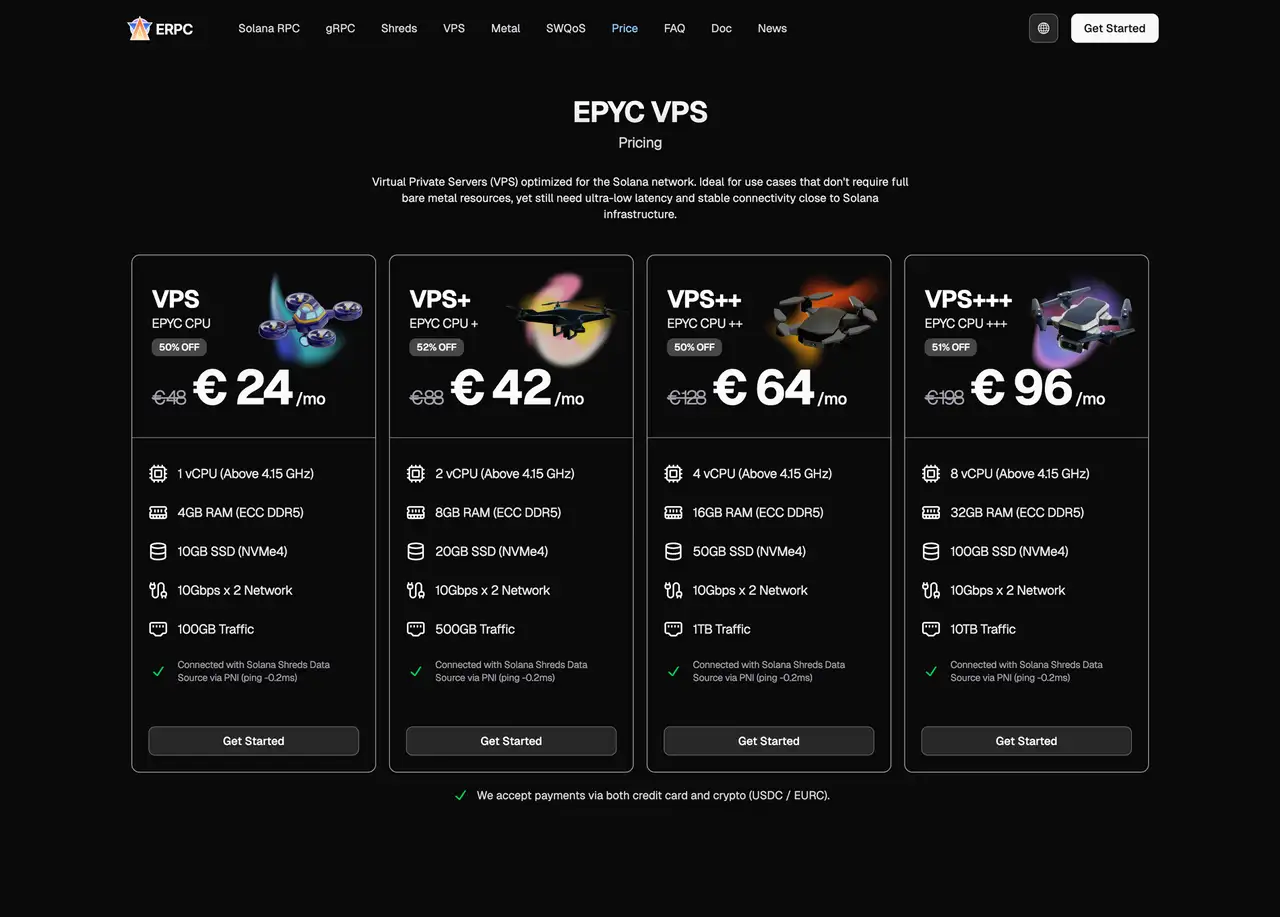
Users can select the most appropriate plan based on their specific use case and architecture.
Ongoing Research and Development
ERPC will continue its research and development efforts with a focus on balancing latency and stability in its Solana RPC infrastructure. This includes the planned migration of Frankfurt-region nodes following completion of Firedancer’s SWQoS support, as well as incremental and continuous improvements across the platform.
ERPC prioritizes long-term evolution as an infrastructure capable of sustaining real-world production workloads.
New Year’s Message
Happy New Year.
We sincerely thank all users for their continued support throughout the past year.
We sincerely thank all users for their continued support throughout the past year.
In 2026, ERPC will continue to evolve as a production-grade Solana infrastructure platform, advancing both speed and stability.
We look forward to your continued support of ERPC.
We look forward to your continued support of ERPC.
Inquiries and Consultation
For consultation regarding architecture design, regional selection, or combining Unlimited Endpoints with VPS, please contact us via the Validators DAO official Discord.
Validators DAO Official Discord: https://discord.gg/C7ZQSrCkYR
ERPC Official Website: https://erpc.global/en/
ERPC Official Website: https://erpc.global/en/