
ERPC Introduces 5th Gen EPYC Lineup for Solana Dedicated Geyser gRPC with Performance Optimization — P99 Latency Improved by 200–300ms, Max Configuration on Months-Long Waitlist
ERPC Introduces 5th Gen EPYC Lineup for Solana Dedicated Geyser gRPC with Performance Optimization — P99 Latency Improved by 200–300ms, Max Configuration on Months-Long Waitlist
ERPC, operated by ELSOUL LABO B.V. (Amsterdam) and Validators DAO, is pleased to announce the addition of AMD EPYC 5th Generation CPU configurations to the Solana Dedicated Geyser gRPC Stream lineup, along with the application of R&D-driven performance boosts and gRPC optimizations across all plans.
As a combined result of hardware refresh and optimization, P99 latency has improved by 200–300ms compared with previous-generation, pre-optimization configurations. The fastest configuration, Max, currently has a months-long waitlist.
5th Gen EPYC Lineup Overview
Three Configurations — Standard / Pro / Max
The Dedicated Geyser gRPC Stream lineup has been refreshed with the addition of 5th Gen EPYC-powered Pro and Max configurations. Standard continues as a high-value option based on 4th Gen EPYC.
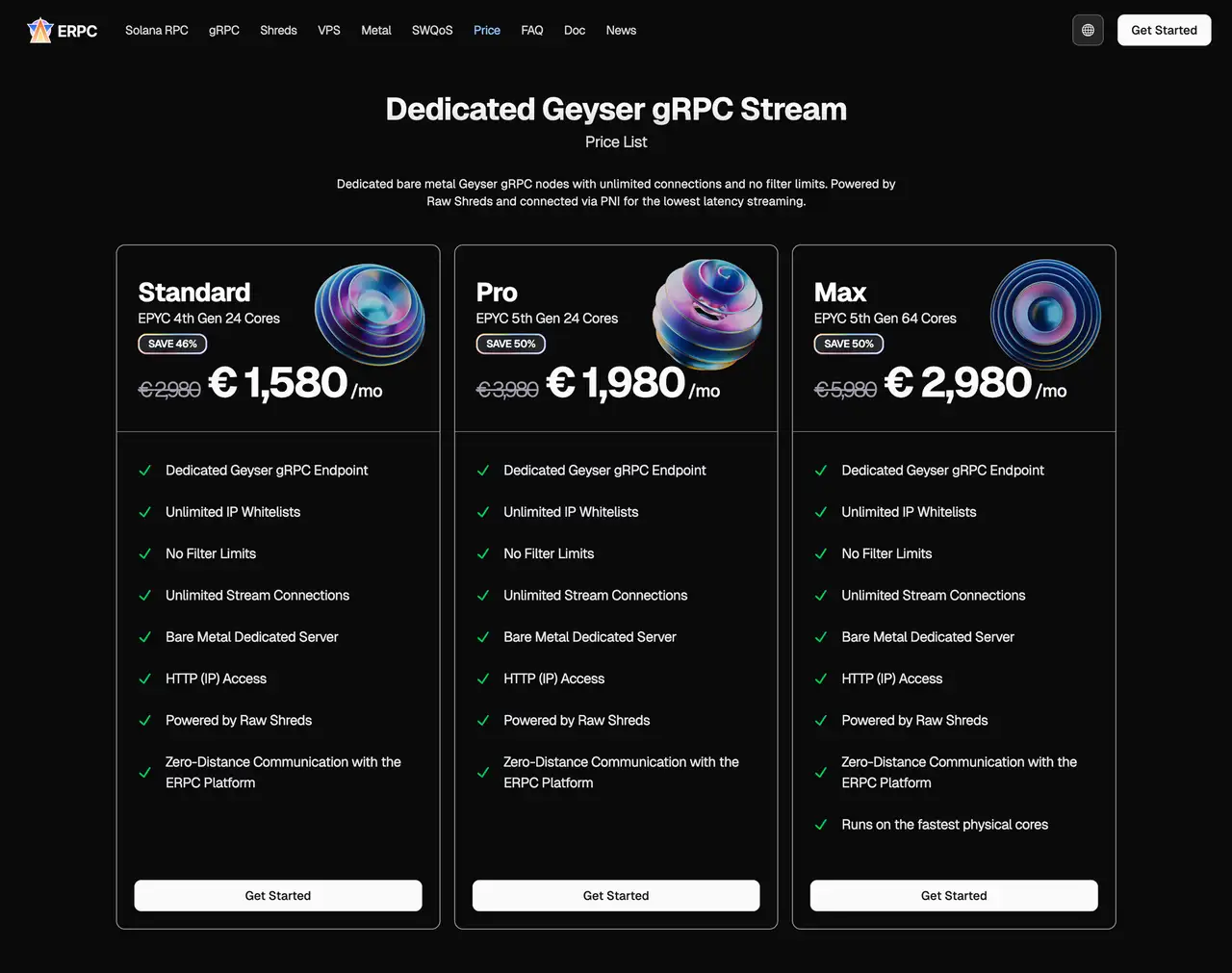
- Standard (€1,580/mo) — EPYC 4th Gen 24 Cores. Cost-effective dedicated gRPC configuration
- Pro (€1,980/mo) — EPYC 5th Gen 24 Cores. High-speed configuration leveraging full 5th generation processing power
- Max (€2,980/mo) — EPYC 5th Gen 64 Cores. Exceptional performance through a physical-core-centric architecture
All plans include a dedicated Geyser gRPC endpoint, unlimited IP whitelists, no filter limits, unlimited stream connections, a physically dedicated bare metal server, HTTP (IP) access, powered by Raw Shreds, and zero-distance communication with the ERPC platform as standard.
ERPC gRPC: https://erpc.global/en/grpc/
Max Configuration — Performance Worthy of the Fastest Name
The Max configuration features an EPYC 5th Gen 64-core large-scale core architecture. All 64 physical cores operate in a fully optimized state. With IRQ optimization and full-stack tuning, this physical-core-centric architecture delivers exceptional latency improvements without relying on logical threads.
The large core count also directly contributes to stability. In gRPC streaming, processing numerous filters and concurrent connections while maintaining low latency on each individual stream — this balance of speed and stability is achieved through the sheer abundance of physical core resources.
The Pro configuration has a wait time of several weeks, and Standard is subject to availability.
P99 Latency Improved by 200–300ms
This lineup refresh combines the transition to 5th Gen EPYC with the simultaneous application of R&D-driven performance boosts and gRPC optimizations. Compared with previous-generation (4th Gen), pre-optimization configurations, P99 latency in gRPC stream processing has improved by 200–300ms.
In Solana, this level of latency improvement represents a difference that can affect Geyser gRPC stream arrival order and subsequent execution decisions in real-world operation. In high-frequency trading, DeFi, and real-time processing, receiving stream data hundreds of milliseconds earlier translates into a competitive advantage in the race for transaction landing order.
Performance Boost Design Philosophy
Thorough Elimination of Power-Saving and Performance-Throttling Features
This performance boost is founded on the design philosophy of thoroughly eliminating every power-saving and performance-throttling feature.
In the server industry, conservative designs prioritizing stability, power efficiency, and general-purpose flexibility are the norm. However, in high-frequency processing where milliseconds matter in Geyser gRPC stream reception and delivery, these conservative settings become direct ceilings on performance.
Disabling CPU C-states, locking the CPU governor to performance mode, optimizing kernel parameters, tuning the network stack, optimizing memory settings, optimizing IRQ affinity, and adopting a physical-core-centric execution model that does not rely on logical threads — speed-limiting factors have been eliminated at every layer, with a speed-first configuration optimized for gRPC stream processing.
Supported Regions
The performance boost has been applied across all 6 regions:
- Frankfurt
- Amsterdam
- London
- New York
- Singapore
- Tokyo
Why We Build the Fastest Platform Ourselves
Trust and Brand Alone Cannot Deliver the Fastest
The reason we committed to building our own fastest platform is clear. We learned the reality that as long as you place servers in a datacenter, trust and brand alone cannot secure the fastest environment.
The server industry has a structural tendency for the quality of resources provided to vary depending on the customer's level of knowledge. Datacenter operators have a constant incentive to save on power and network bandwidth to improve profitability — improved customer performance does not translate to increased datacenter revenue.
We have experienced receiving a quote for the "fastest" setup that included a 10-year-old network card. If the customer does not audit, performance bottlenecks can easily go unnoticed — this is the reality of the server industry.
This structure acts as a barrier to innovation. In an era where AI agents enable even small teams to achieve outsized results, an environment where infrastructure bottlenecks hold back users without deep infrastructure expertise cannot be considered mature.
The Structural Problem ERPC Solves
Traditionally, building a high-speed gRPC streaming environment on Solana required investigating the physical location of RPC vendor servers, procuring bare metal servers within the same network, auditing and disabling performance-throttling features, and full-stack OS-level tuning — all demanding broad and deep expertise.
ERPC integrates the Solana RPC platform with bare metal servers, VPS, Shreds, gRPC, and Unlimited Endpoints that users deploy, all within a single platform. Simply deploying within the platform provides the fastest communication conditions, pre-optimized configurations, and Solana-specific tuning from the start.
You can access the fastest environment without deep datacenter expertise — this is the design philosophy of ERPC, and the reason we continue to build our own platform.
Five Consecutive Years of WBSO Recognition — R&D Directly Reflected in Performance
ELSOUL LABO has been consecutively approved since 2022 under the Dutch government's WBSO R&D incentive program. We continue research on ultra-low-latency Solana RPC infrastructure and automation of validator placement and operational orchestration, with results directly reflected in platform performance improvements.
The 5th Gen EPYC lineup and performance boost are the materialization of knowledge accumulated through this ongoing R&D. R&D results compound over time, and the angle of improvement grows steeper with each iteration.
The Next Generation — AS200261 Solana-Optimized Datacenter
ELSOUL LABO has been assigned its own ASN (AS200261) by RIPE NCC and is progressing the launch of a Solana-optimized top-tier datacenter. Designed to surpass existing premium datacenters as the highest-quality infrastructure, it is scheduled to become available from late this month into next month.
The hardware platform is standardized on the latest-generation AMD EPYC 5th Gen, AMD Threadripper PRO 5th Gen (9975WX and others), and NVMe 5th Gen, complemented by optimal network routing through our own ASN. This delivers the ideal solution that simultaneously satisfies both performance and ASN concentration score — conditions previously considered mutually exclusive.
The initial lot is sold out by reservation, but subsequent inventory will be offered in waitlist order.
Contact
For inquiries about Dedicated Geyser gRPC Stream, please create a support ticket on the official Validators DAO Discord.
Validators DAO Official Discord: https://discord.gg/C7ZQSrCkYR
For official ERPC information and plans, please visit:
ERPC Official Website: https://erpc.global/en
Thank you for your continued support of ERPC.
News